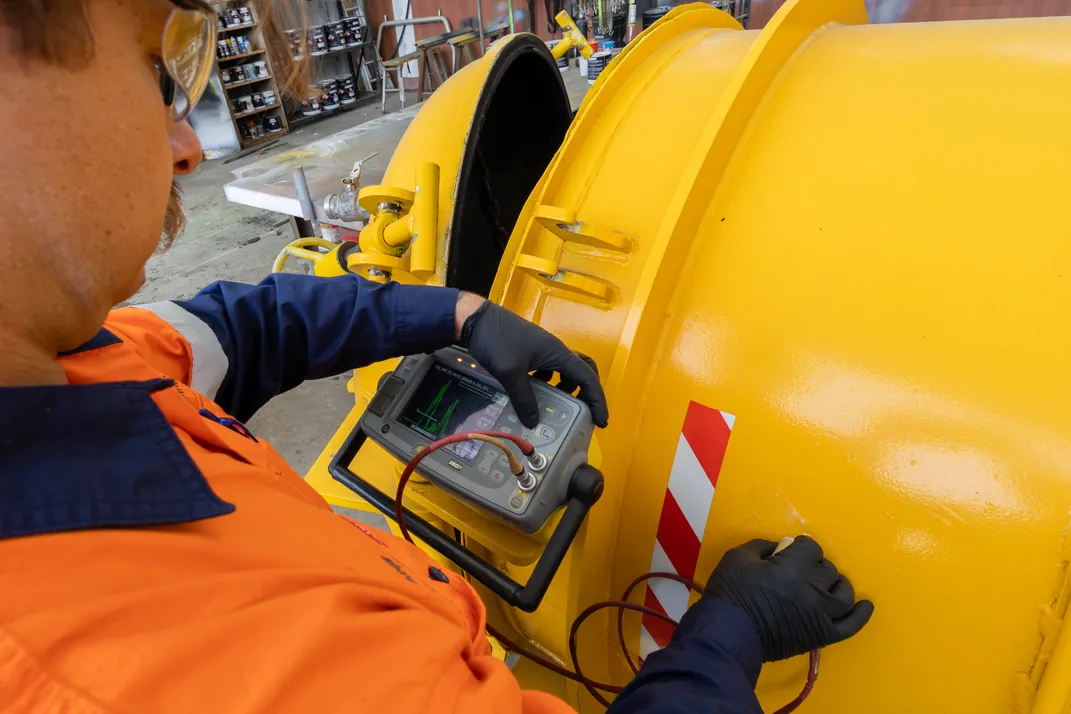
What AS 4343 Hazard Levels Are
AS 4343 is the Australian standard that ranks pressure equipment by hazard. It gives each boiler, pressure vessel or pressure piping system a hazard level from A (highest) to E (lowest), based on how much energy the equipment stores and what would be released if it failed. If you just want the answer for one vessel, our free AS 4343 hazard level calculator does the sums as you type and shows the working. This guide explains what it is doing, so you can check the result yourself.
The hazard level is not a rating of a vessel's condition. A brand-new vessel and a corroded one with the same pressure, volume and contents have the same hazard level. What the level does is help decide how the vessel is treated under work health and safety (WHS) law, most visibly whether its design and the vessel itself must be registered with the regulator.
AS 4343 sits alongside Australia's other pressure equipment standards, such as AS/NZS 1200, the AS 1210 design standard and the AS/NZS 3788 in-service inspection standard. Our map of Australian pressure equipment standards shows how they fit together. WHS regulations generally reference AS 4343:2014 at the time of writing, and that is the edition used throughout this guide.
The Formula, Step by Step (P, V, Fc, Ff, Fs)
For most pressure vessels, the hazard level comes from a single number, H, worked out as:
H = P × V × Fc × Ff × Fs
Each term is simple on its own:
- P is the design pressure in MPa. Use the design pressure from the nameplate or the manufacturer's data report, not the pressure the vessel normally runs at. Convert first: 800 kPa is 0.8 MPa, 1 bar is 0.1 MPa, and 1 psi is about 0.00689 MPa. Design pressure is set when the vessel is designed, for example to AS 1210.
- V is the internal volume in litres. Again, take it from the nameplate or data report where you can. If you have to estimate it from the shell diameter and length, the result is only as good as the estimate.
- Fc is the fluid state factor. It reflects how much more energy a compressed gas stores than a liquid at the same pressure: 10 for a gas or vapour, 1 for a liquid and 0.1 for vacuum. A liquid held above its atmospheric boiling point needs care, so check your copy of the standard for how to classify it.
- Ff is the fluid hazard factor. It reflects how harmful the contents are if released: 1/3 for a non-harmful liquid, 1 for a non-harmful gas such as clean air, 3 for harmful, 10 for very harmful and 1,000 for lethal contents.
- Fs is the service factor. It starts at 1. AS 4343's special service conditions include fired equipment, a quick-actuating closure, a location within a major hazard facility, a transportable vessel over 200 L and human occupancy. One condition raises Fs to 3, and two or more raise it to 10. The transportable and human-occupancy conditions are counted on their own rather than added to fired equipment, quick-actuating closures and major hazard facilities, so check the standard's wording where they combine. A design pressure above 50 MPa applies a factor of 30. Where the standard's mitigating conditions apply, Fs is reduced to 1/3 for one or 1/10 for two or more, though not for fired equipment. Check the standard's own wording for the full conditions and thresholds before relying on Fs.
Then read H against the AS 4343:2014 bands:
| Hazard level | H value (AS 4343:2014) |
|---|---|
| A (highest) | Above 108.5 (about 3.16 × 10⁸) |
| B | Above 10,000, up to 108.5 |
| C | Above 1,000, up to 10,000 |
| D | Above 102.5 (about 316), up to 1,000 |
| E (lowest) | Up to 102.5 (about 316) |
A value that lands exactly on a boundary takes the lower level. AS 4343 also has provisions that set the level directly for some kinds of equipment, and separate treatment for piping and multi-chamber vessels. The formula above is the method for an ordinary single-chamber vessel, so check your copy of the standard where your equipment is unusual.
Using the APEC Calculator
The APEC hazard level calculator follows the same steps, in the same order, and shows its working. It is free, needs no sign-up, and the result appears as you type.
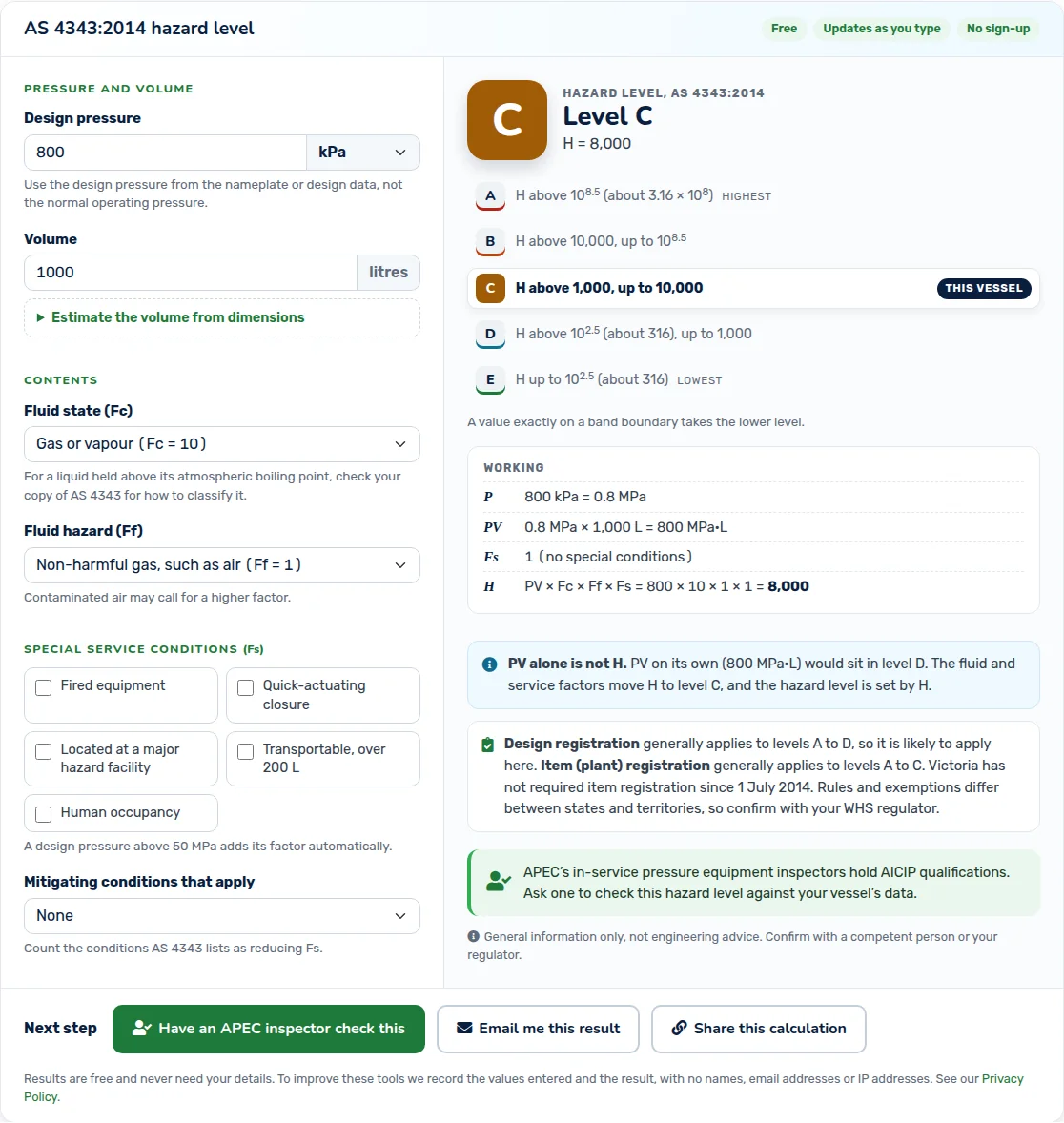
- Pressure and volume: enter the design pressure and choose the unit (kPa, bar, MPa or psi), then the volume in litres. If you only know the dimensions, open Estimate the volume from dimensions.
- Contents: choose the fluid state (Fc) and the fluid hazard (Ff) from the lists.
- Special service conditions: tick any that apply. A design pressure above 50 MPa adds its factor automatically, and you choose how many of the standard's mitigating conditions apply (none, one, or two or more), which reduces Fs except for fired equipment.
- Read the result: the panel shows the hazard level, where H sits on the A to E ladder, the PV, Fs and H working, and a general note on registration.
From the result you can have an APEC inspector check it, email it to yourself or share a link to the calculation with a colleague. The working is shown so you can check the numbers against your own copy of AS 4343:2014; the calculator is general information, not engineering advice.
Worked Example 1: 1,000 L Air Receiver at 800 kPa → Level C
A typical workshop air receiver: a design pressure of 800 kPa on the nameplate, 1,000 L volume, clean compressed air, no special service conditions. Air is generally treated as non-harmful only within a set temperature range; check AS 4343 for very cold or hot service.
- P = 800 kPa = 0.8 MPa
- V = 1,000 L
- Fc = 10 (gas)
- Ff = 1 (non-harmful gas)
- Fs = 1 (no special conditions)
H = 0.8 × 1,000 × 10 × 1 × 1 = 8,000. That is above 1,000 and up to 10,000, so the receiver is hazard level C.
Air receivers like this are common in workshops, plant rooms and on service vehicles. A receiver of this size sits at Level C rather than at the bottom of the scale, and the gas factor of 10 is the reason. If the air is contaminated, for example with oil carry-over, a higher fluid hazard factor may apply, so think about what is actually in the vessel.
Worked Example 2: 1.2 L Hydraulic Accumulator at 21 MPa → Level E
A small hydraulic bladder accumulator, the kind fitted to mobile plant and hydraulic power packs: a 1.2 L shell with a 21 MPa design pressure. The gas side holds a nitrogen precharge, treated here as a non-harmful gas, and there are no special service conditions.
H = 21 × 1.2 × 10 × 1 × 1 = 252. That is below 102.5 (about 316), so the accumulator is hazard level E.
The pressure is more than 25 times that of the air receiver, yet the hazard level is two steps lower, because the stored volume is tiny. This is why the hazard level is not just about pressure. Level E does not mean the accumulator can be ignored. It still needs to be fit for service, and how often it is inspected is a matter for your inspection plan under AS/NZS 3788, not the hazard level alone.
Worked Example 3: Exactly on a Boundary (H = 1,000 → Level D Under 2014)
Now a gas vessel with a 1.0 MPa design pressure and a 100 L volume, holding clean air, with no special service conditions.
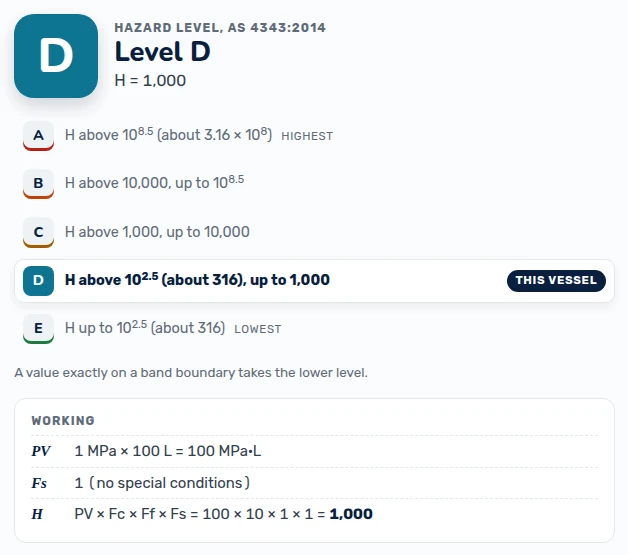
H = 1.0 × 100 × 10 × 1 × 1 = 1,000 exactly. Under AS 4343:2014 a value on a boundary takes the lower level, so this vessel is hazard level D, not C.
Change the volume to 101 L and H becomes 1,010, which is Level C. Boundary cases like this are where small differences matter: a rounded volume, an estimated rather than nameplate figure, or a design pressure converted from a different unit can move a vessel between levels. If your result is on or very close to a boundary, confirm the inputs from the data report before relying on it.
Why PV on Its Own Is Not the Hazard Level
People often quote a vessel's PV, its pressure multiplied by volume, as if it were the hazard level. It is not. PV is only the first part of the calculation.
Take the air receiver from Example 1. Its PV is 0.8 MPa × 1,000 L = 800 MPa·L. If you read 800 against the bands, it looks like Level D. But the vessel holds a gas, so Fc multiplies it by 10, and the real H is 8,000: Level C. The same mistake can go the other way. A vessel full of a non-harmful liquid has an Ff of 1/3, so its H is lower than its PV.
Whenever you see a hazard level quoted from PV alone, ask which fluid factors were applied. The calculator shows PV, Fs and H separately for exactly this reason.
What the Level Means for Registration
Hazard levels are used by the WHS regulations to decide which pressure equipment must be registered. In general terms:
- Design registration generally applies to pressure equipment, other than pressure piping, at hazard levels A to D.
- Item (plant) registration generally applies to pressure vessels at hazard levels A to C, with exceptions.
- Victoria has not required item registration of pressure equipment since 1 July 2014.
The rules, and the exemptions within them, differ between states and territories, so confirm with your state or territory WHS regulator before deciding a vessel does not need registering. Our guide to pressure vessel compliance in NSW covers the NSW position in more detail.
Registration is separate from inspection. A registered vessel still needs in-service inspection, and an unregistered one is not exempt from being kept safe. The calculator's result panel gives a general registration note for the level it finds, as a starting point for that conversation with your regulator.
AS 4343:2014 and the 2026 Edition
A 2026 edition of AS 4343 has reportedly been published. WHS regulations, for example in Western Australia, refer to the 2014 edition, so registration questions are generally still assessed against AS 4343:2014.
That is why this guide and the calculator both use the AS 4343:2014 bands. If your regulator adopts the newer edition, results near a band boundary may change. Check with your regulator which edition applies to your equipment.
When to Get an Inspector Involved
A calculator gives you a number. Getting an inspector involved is worthwhile when:
- the result sits on or near a band boundary, or depends on an estimated volume or pressure;
- the contents are mixed, contaminated or hard to classify, or a liquid is held above its boiling point;
- special service or mitigating conditions may apply and you are unsure which;
- the nameplate or data report is missing, or the vessel has been modified or re-rated;
- the vessel is due for in-service inspection, or you are setting up an inspection plan under AS/NZS 3788.
APEC's in-service inspection reports record the vessel's hazard level, alongside the inspection findings. Our in-service inspectors hold AICIP qualifications and inspect to AS/NZS 3788, and APEC is accredited by NATA to ISO/IEC 17025, with non-destructive testing carried out by technicians certified to ISO 9712 through AINDT.
Start with the free calculator, then use Have an APEC inspector check this to send us the result, or contact APEC with your vessel's nameplate details and data report. Our pressure vessel inspection page explains what an in-service inspection involves.