Compare two phased array apertures
Check whether a focal law (the set of element delays that focuses the beam) can focus where you want it. Enter the probe, material and two apertures to compare near-field length, effective focal depth and focal spot width side by side.
Loading the calculator…
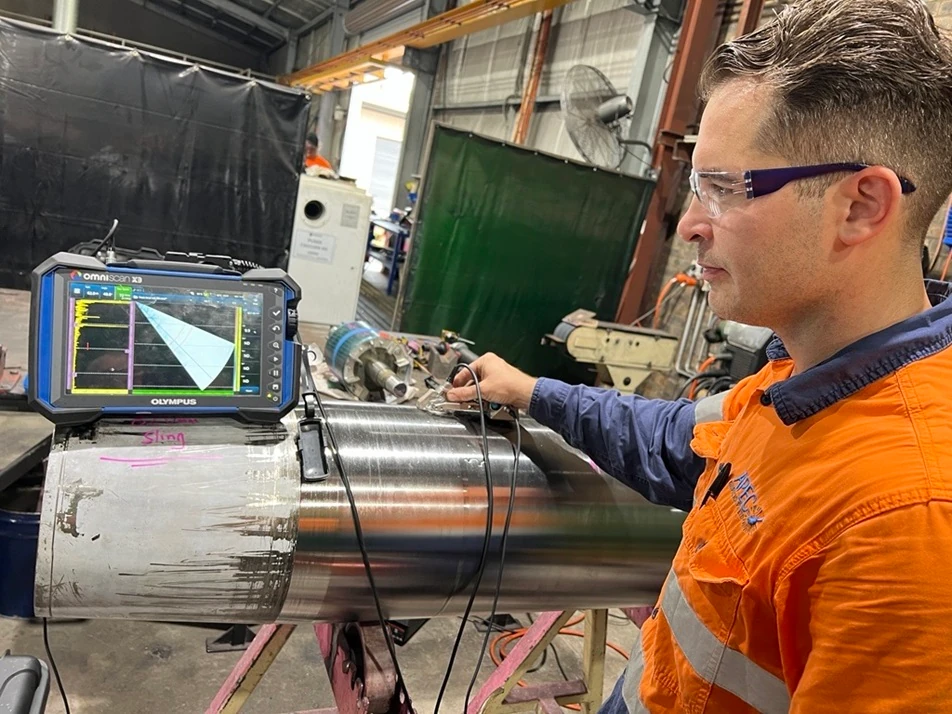
APEC’s NDT technicians are certified to ISO 9712 through AINDT and carry out phased array ultrasonic testing on welds and plant equipment.
General information only, not engineering advice. Confirm with a competent person or your regulator.
Results are free and never need your details. To improve these tools we record the values entered and the result, with no names, email addresses or IP addresses. See our Privacy Policy.
A calculator gives you a number. An inspector tells you what it means.
Focusing performance depends on details a calculator cannot see: the probe’s element length, the wedge, steering angles and the material itself. APEC’s PAUT technicians can help you set up and verify focal laws for your inspection.
NATA accredited
APEC Inspection is accredited by NATA to ISO/IEC 17025:2017 for its non-destructive testing techniques.
AINDT-certified technicians
Our NDT technicians are certified to ISO 9712 through the Australian Institute of Non-Destructive Testing (AINDT).
AICIP-qualified inspectors
Our in-service pressure equipment inspectors hold qualifications with the Australian Institute for the Certification of Inspection Personnel (AICIP).
How this calculator works
The calculator uses the standard textbook relationships for a linear phased array focusing at normal incidence.
- Wavelength. λ = v ÷ f. With velocity in mm/µs and frequency in MHz, λ is in millimetres.
- Active aperture. A = n × p: the number of active elements times the element pitch.
- Near-field length. N = A² ÷ 4λ. This is where an unfocused aperture of that size reaches its natural focus, and it is the deepest point it can be focused electronically.
- Effective focal depth. The smaller of the focal depth you enter and N. If you ask for focus at or beyond N, the calculator uses N and warns you.
- Normalised focal depth. F ÷ N is the focal depth you enter divided by the near-field length. It shows how far inside the near field the focus sits; lower values give a tighter, better-defined focal spot. At 1 or more the focus is capped at N, and the result says so.
- Focal spot width. −6 dB width ≈ 1.02 × λ × F ÷ A, in the active (steering) plane (the plane along the row of elements), with F the effective focal depth. The 1.02 factor is a common approximation; treat the figure as a planning estimate rather than an exact width.
Entering two apertures side by side shows the trade-off between element count, near-field length and spot size for the same probe and material.
Assumptions and limits
- Focal depth is the sound path in the test material. Wedge delay, refraction and steering angle are not included. Steering shrinks the effective aperture (roughly A × cos of the steering angle), which shortens N and widens the spot.
- As the focal depth approaches the near-field length (F/N above about 0.6), the actual point of highest pressure sits shallower than the depth entered and the spot formula becomes less reliable. Treat results near F/N = 1 as an upper bound.
- N uses the active aperture only. For a rectangular aperture the element length (passive aperture) also affects the near field, most when the active aperture is similar to the element length. Check N against your probe data or beam modelling.
- Results apply to the active (steering) plane. Beam width in the passive plane depends on the element length and is not calculated.
- The aperture is elements × pitch; the gap between elements is ignored.
- The formulas are standard approximations. Real beams also depend on probe design, bandwidth and attenuation, so verify focal laws with your instrument’s calculator, beam modelling or a reference block.
- Velocity presets are typical values. Measure the velocity of your material where accuracy matters.
Frequently asked questions
What is the near field of a phased array aperture?
It is the region in front of the active aperture where the sound field is shaped by interference between waves from different parts of the aperture. Its length, N = A squared divided by 4 times the wavelength, depends on the aperture size and the wavelength. Electronic focusing only works within the near field.
Why can't a probe focus beyond the near-field length?
Beyond N the beam from the aperture is already spreading. Applying focal delays for a deeper point does not bring the beam back together, so the practical focus stays at or short of N. The calculator caps the effective focal depth at N and shows a warning.
How do I get a smaller focal spot?
Use a larger aperture, a higher frequency (shorter wavelength) or a shallower focal depth. Each has a cost: more elements, more attenuation at higher frequencies, and less depth of field.
Does the calculator allow for the wedge?
No. Depths are sound paths in the test material. Wedge delay, refraction and beam steering all change the real focal position, so use your instrument's focal law calculator or beam modelling software when building a scan plan.
How accurate is the focal spot width?
It is a widely used approximation for the -6 dB beam width in the active plane. Actual widths depend on the probe, its bandwidth, the material and the steering angle. The 1.02 factor is a common approximation; treat the figure as a planning estimate rather than an exact width.
Can APEC help with phased array inspection?
Yes. APEC carries out phased array ultrasonic testing on welds and plant equipment, and its NDT technicians are certified to ISO 9712 through AINDT. Use the inspector check button or call (02) 4062 0305 to discuss your inspection.
Related services and guides
- Phased array ultrasonic testingAPEC's PAUT inspection service
- Phased array ultrasonic testing explainedTechniques and where PAUT is used
- Phased array weld inspectionHow PAUT finds weld flaws
- Ultrasonic inspectionConventional UT, thickness testing and more
- AS/NZS 1554.1 weld imperfection calculatorAssess RT or UT indications on Category SP welds
- All calculatorsAS 4343 hazard level and the other free tools